
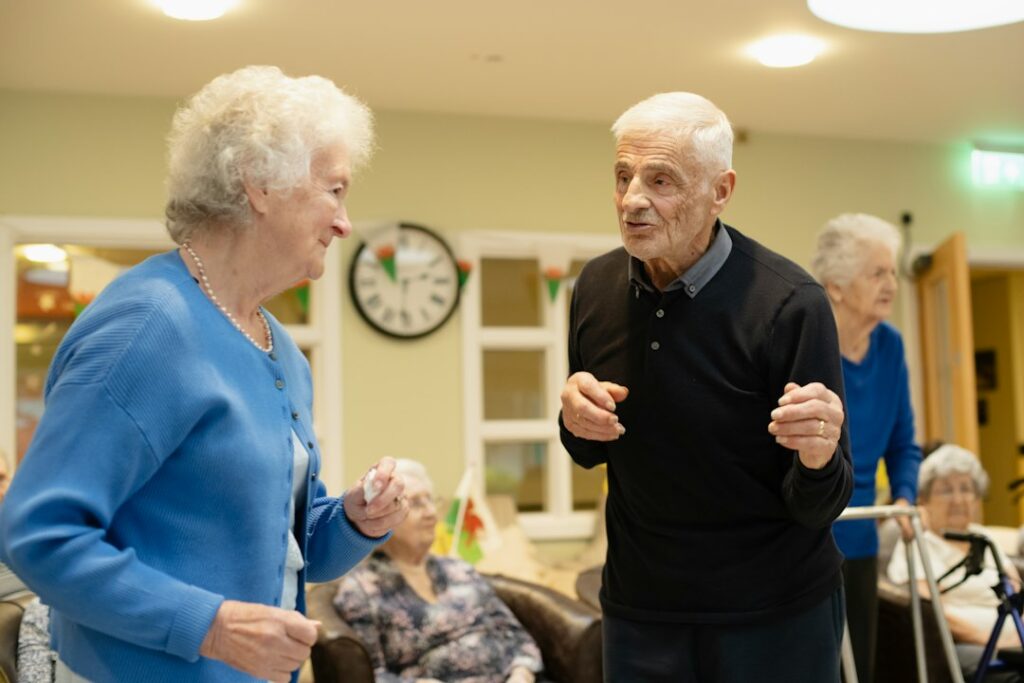
What should a fitness program in assisted living include?
A well-designed fitness program for older adults should support strength, balance, endurance, flexibility, and confidence with everyday movement. It should also be adaptable for residents who use walkers, wheelchairs, canes, oxygen, or other mobility supports.
Exercise in assisted living is not limited to formal classes. Walking to meals, practicing sit-to-stand movements, stretching after breakfast, participating in seated activities, and taking part in group programs can all contribute to physical health.
The goal is not athletic performance. The goal is to help residents remain as capable, comfortable, and independent as possible while reducing avoidable risks such as falls, weakness, stiffness, and prolonged sitting.
Why is exercise important for assisted living residents?
Regular physical activity can help older adults maintain muscle strength, support balance, improve mood, and make daily tasks easier. These benefits may affect practical activities such as standing from a chair, getting dressed, reaching for an item, or walking through a dining area.
Movement may also support better sleep and help manage some chronic health conditions. Residents with arthritis may find that gentle activity helps reduce stiffness, while those with limited endurance may gradually tolerate more walking or seated exercise.
Exercise can also provide social connection. A small group class gives residents an opportunity to talk, encourage one another, and develop a familiar routine. For someone adjusting to assisted living, that social benefit can be just as meaningful as the physical activity.
What types of exercises are most useful?
Most senior fitness programs combine several types of movement rather than focusing on only one.
Strength exercises
Strength activities help maintain the muscles needed for transfers, walking, posture, and daily tasks. Examples include:
- Standing up and sitting down from a sturdy chair
- Leg extensions while seated
- Wall push-ups or modified push-ups
- Light hand weights
- Resistance bands
- Seated marches
- Heel raises while holding a stable surface
Exercises should be performed slowly and with controlled movement. The amount of resistance should allow a resident to complete the activity without straining, holding the breath, or losing proper form.
Balance exercises
Balance training is especially valuable because falls can lead to serious injuries and loss of confidence. Appropriate activities may include:
- Shifting weight from side to side
- Walking along a hallway with support nearby
- Practicing heel-to-toe steps
- Standing from a seated position
- Moving one foot forward and back
- Gentle tai chi movements
- Standing with one hand near a sturdy chair or rail
Balance exercises should never require a resident to take unnecessary risks. A chair, wall, railing, or trained helper should be available when needed.
Endurance activities
Endurance exercises raise the heart rate and help residents tolerate movement for longer periods. Indoor walking is often practical in Clearfield, PA, particularly during icy, snowy, or very cold weather. Other options may include seated aerobic routines, hallway walking, dancing to familiar music, or repeated short walks throughout the day.
A resident does not need to complete one long workout to benefit. Several five- or ten-minute activity periods can be more realistic than a single extended session.
Flexibility and range-of-motion exercises
Stretching and gentle joint movements may help residents move more comfortably. Examples include shoulder rolls, ankle circles, neck movements, seated trunk turns, and reaching exercises.
Stretching should feel gentle rather than painful. Movements should not be forced, bounced, or held while the resident is holding their breath.
How can exercise be adapted for different abilities?
A safe program offers more than one version of each activity. A walking exercise might be performed while standing, holding a support, or seated. A strength exercise might use no equipment, a light resistance band, or a small weight depending on the resident’s ability.
Residents who use wheelchairs can often participate in upper-body exercises, seated marches, posture activities, reaching exercises, and adapted balance work. Residents with memory loss may benefit from short, familiar routines with visual demonstrations and simple instructions.
Programs should account for:
- Vision or hearing limitations
- Arthritis or joint pain
- Parkinson’s disease or other movement conditions
- Stroke-related weakness
- Heart or lung conditions
- Diabetes
- Osteoporosis
- Recent surgery or injury
- Fear of falling
- Fatigue or medication-related dizziness
A resident does not need to perform every exercise in the same way as others in the group. Participation should be based on individual ability, comfort, and safety.
How much exercise do older adults need?

General guidance for adults age 65 and older includes aerobic activity during the week, muscle-strengthening activity on at least two days, and regular balance exercises. The commonly cited target is 150 minutes of moderate-intensity aerobic activity per week, but that amount may not be realistic for every assisted living resident.
Residents with chronic conditions, disabilities, or significant mobility limitations should be as active as their abilities allow. Short periods of movement are still useful. Increasing activity gradually is usually more appropriate than trying to meet a fixed number immediately.
A practical weekly routine might include:
- Short indoor walks on most days
- Strength exercises two days each week
- Balance practice several times each week
- Gentle stretching or range-of-motion exercises daily
- Frequent opportunities to stand, reposition, or avoid long periods of sitting
Progress may be measured by improved confidence, easier transfers, longer walking tolerance, or greater participation in daily activities—not just by minutes completed.
What safety practices matter most?
Residents should follow the instructions provided for their individual health needs. Someone with a new medical concern, recent fall, chest discomfort, unusual shortness of breath, fainting, severe pain, or sudden weakness should pause exercise and receive appropriate medical attention.
Additional safety practices include:
- Wear secure, well-fitting shoes with nonslip soles.
- Keep pathways clear of rugs, cords, spills, and clutter.
- Use prescribed mobility devices correctly.
- Start slowly and allow time for warming up and cooling down.
- Drink fluids as allowed by individual medical guidance.
- Avoid exercising immediately after a heavy meal if that causes discomfort.
- Stop if there is sharp pain, dizziness, unusual breathlessness, or a feeling of instability.
- Avoid comparing one resident’s progress with another’s.
Exercise areas should have adequate lighting, comfortable temperatures, stable chairs, and enough room for mobility devices. During winter, indoor activity may be safer than outdoor walking when sidewalks are slippery or daylight is limited.
What should families ask about an assisted living fitness program?
Families and residents can ask whether activities are adapted for different mobility levels and whether seated options are available. It is also reasonable to ask how staff respond when a resident becomes tired, dizzy, or unsteady during a class.
Other useful questions include:
- Are balance and strength included, or is the program mainly stretching?
- Can residents participate with walkers or wheelchairs?
- Are exercises offered in short sessions?
- How are new residents introduced to the activities?
- Are individual limitations communicated to the activity staff?
- Is participation encouraged without pressuring residents?
- Are indoor walking opportunities available during winter weather?
A strong program treats exercise as part of everyday wellness. It makes movement approachable, allows residents to work at an appropriate level, and connects fitness with the activities that matter most: walking safely, transferring with greater ease, participating socially, and maintaining as much independence as possible.
